
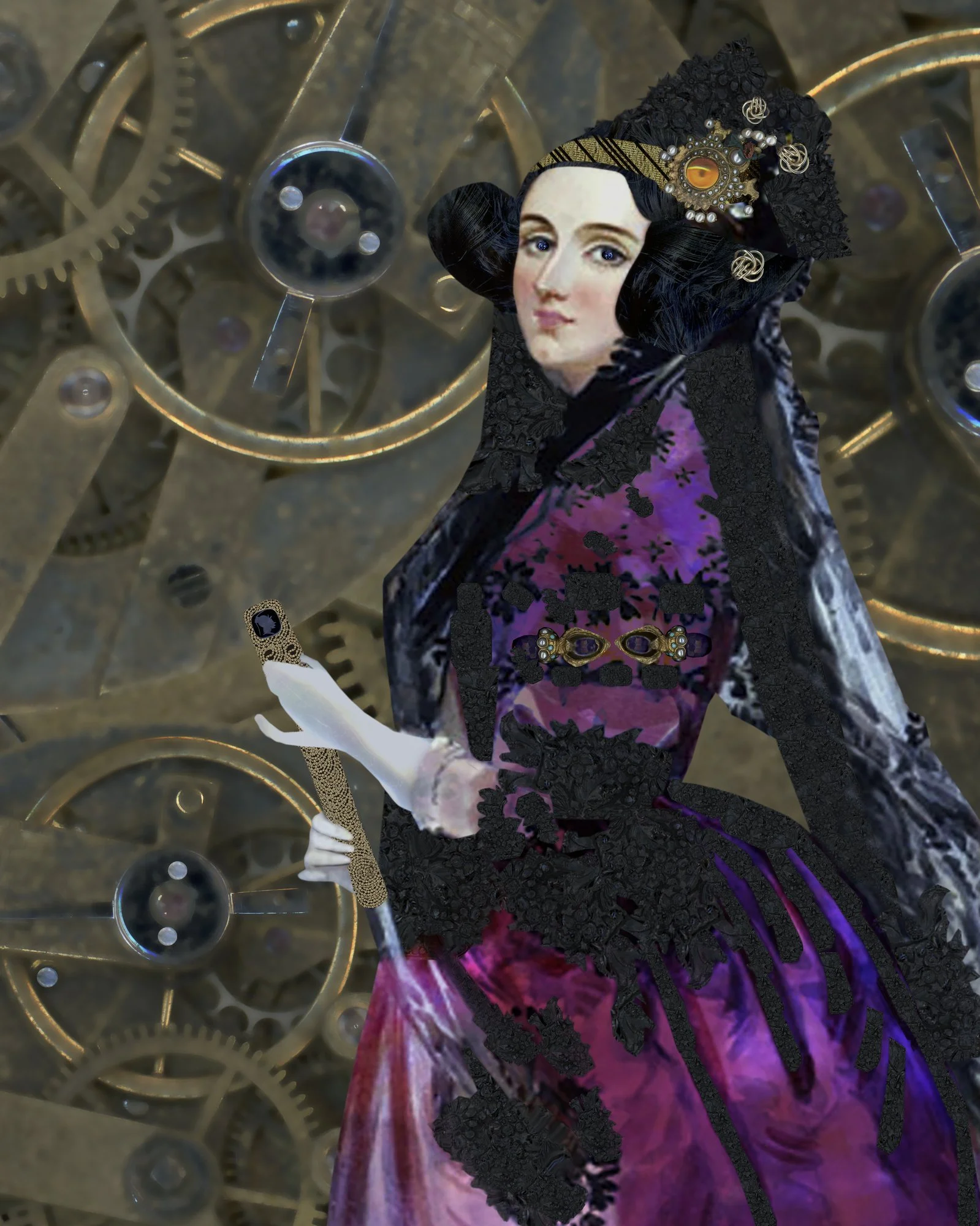
COMPUTE THIS — Ada Lovelace
MATHEMATICIAN | COMPUTER PIONEER
Gears fill the frame behind her — not decoration, but the Analytical Engine itself, the mechanical computer Charles Babbage designed and never finished building. Ada Lovelace is dressed for 1843, the year she published her notes on that machine: heavy Victorian silk and lace, a jeweled eye pinned above her forehead like a third sense trained on something the century around her could not yet see. The eye is the right emblem. At seventeen, Lovelace grasped Babbage's engine more completely than its own inventor had, and where he saw a calculator, she saw a symbol-manipulator — a machine that could work with anything expressible in number, not arithmetic alone. Her notes for a paper on the Analytical Engine included what is now recognized as the first published computer program, and she anticipated, in prose, machines composing music: an idea neither Babbage nor anyone else in the room had reason to imagine. The Engine was never completed in her lifetime; her notes went unread for a century, rediscovered only in the 1950s as computing became real. In 1980 the U.S. Department of Defense named a programming language Ada, a century-late acknowledgment of a mind that saw further into the gears than the man who built them.