
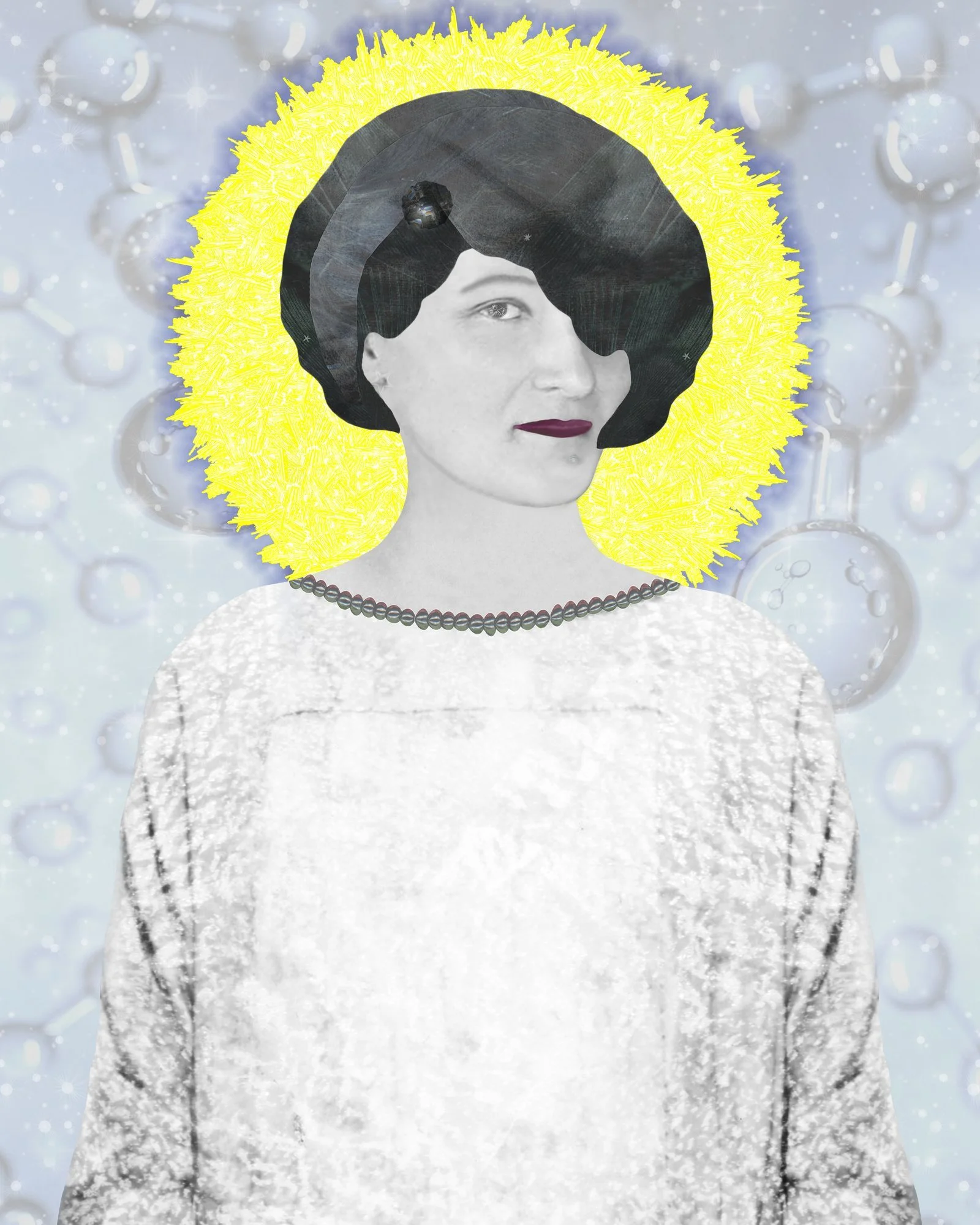
HYDROGEN QUEEN — Cecilia Payne-Gaposchkin
ASTRONOMER | ASTROPHYSICIST
HYDROGEN QUEEN crowns her with the discovery itself. The yellow corona haloing her head is not ornament borrowed from religious portraiture — it is the element she proved dominates every star, worn the way a queen wears a crown she earned rather than inherited. Behind her, a field of pale molecular diagrams and bubbles renders the physics visible: the same spectral analysis that let a twenty-five-year-old graduate student read the composition of stars from light alone. In 1925, Cecilia Payne's Harvard doctoral thesis argued that stars are made overwhelmingly of hydrogen and helium, against the consensus of every senior astronomer reviewing it. She was advised to soften the conclusion before publication, and did. Otto Struve confirmed it four years later under his own name, and for decades the finding carried his authority more than hers. The halo in this collage does what the record was slow to do: it puts the discovery back on her head, in the one color — the burning yellow of hydrogen itself — that no one can reasonably ask her to soften twice.