
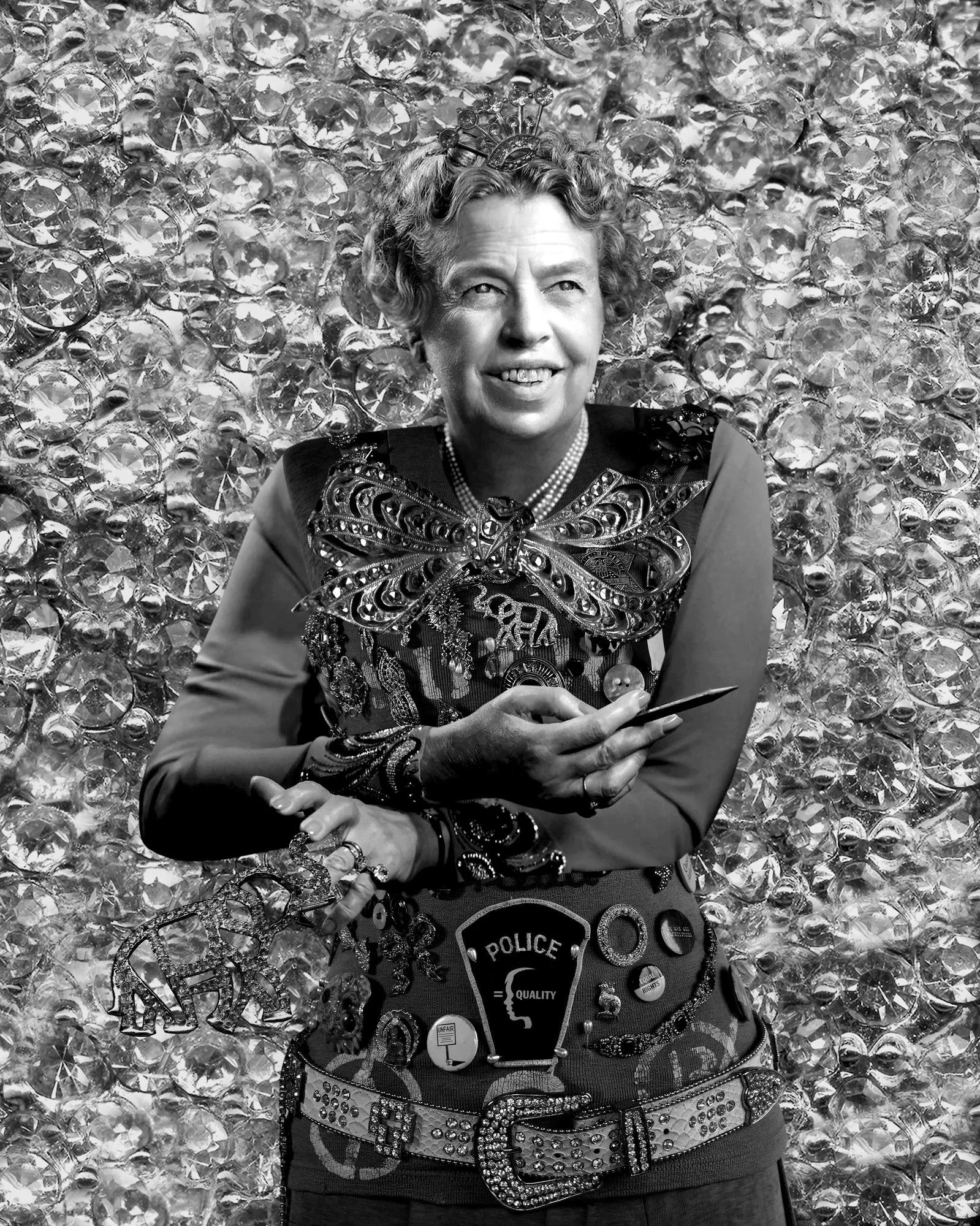
ELEPHANT IN THE ROOM — Eleanor Roosevelt
FIRST LADY | AUTHOR | HUMAN RIGHTS ADVOCATE
The elephant in the room is what the title supplies and the rest of the record withholds: Eleanor Roosevelt's marriage to Franklin Delano Roosevelt, her fifth cousin, whom she met at seventeen, survived his affair with Lucy Mercer — discovered in 1918, a rupture from which the marriage never fully recovered as a romantic one, though it endured as a formidable political partnership. That distinction matters, because it is the hinge her later career turns on: rather than remain the deferential political wife of the period, Eleanor built an independent public life alongside it, leading youth and women's organizations years before her husband became president in 1933. A badge at her waist reads POLICE above =QUALITY — equality rendered as insignia of the law — and it is not incidental: after FDR's death she became a UN delegate, chaired the Commission on Human Rights, and was the principal author of the 1948 Universal Declaration of Human Rights, extending its protections explicitly to the civil rights of African and Asian Americans, the expanded workplace roles of women, and the claims of wartime refugees. Her closest relationships in these later decades were largely with women, most notably the journalist Lorena Hickok, whose extensive surviving correspondence with Eleanor remains genuinely disputed among historians as to its exact nature. The room, in other words, held more than one elephant. The public record only ever addressed the achievements.