
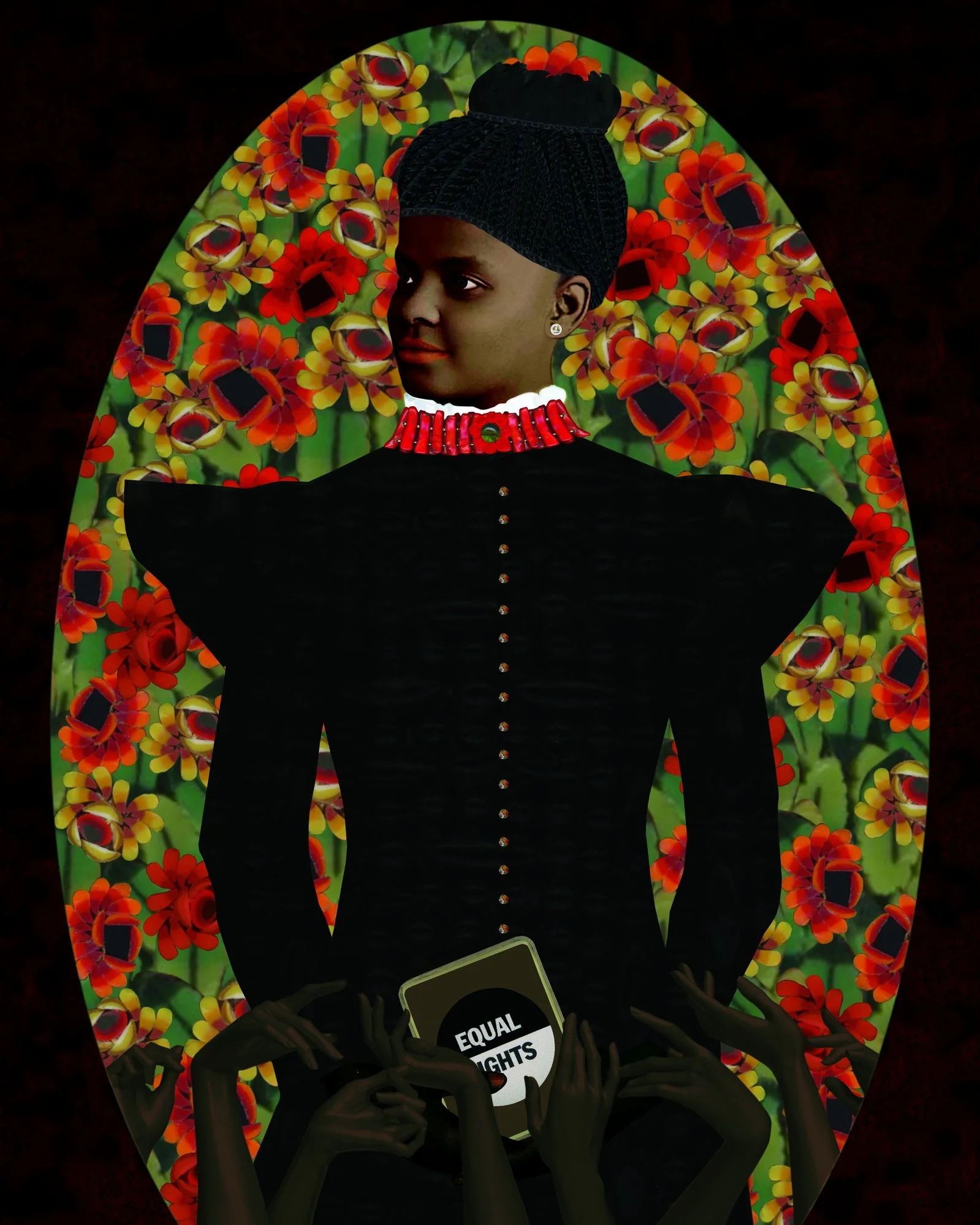
I DEMAND JUSTICE — Ida B. Wells
JOURNALIST | CIVIL RIGHTS ACTIVIST
Below her, a cluster of hands reaches up from outside the frame to hold a single badge reading EQUAL RIGHTS — not her hands alone, a crowd's. It is a fitting image for a woman whose signature method was to make abstractions specific: when Ida B. Wells wrote about lynching, she named the victims individually rather than citing statistics, a deliberate tactic to force readers to see people instead of numbers. Born into slavery, Wells became a journalist who reported at real risk to her life, and in 1884 — seventy-one years before Rosa Parks — she was dragged from a first-class train car she had legitimately paid for and thrown off after biting the conductor who tried to move her; she sued and won, then watched the ruling overturned on appeal. She co-founded the NAACP, pioneered the boycott as a tool of protest decades before the civil rights movement adopted it, and broke publicly with the white suffrage movement when it excluded Black women from its demand for the vote. She ran for the Illinois Senate and lost. History moved past her toward more moderate allies, then caught up to her methods a half-century later. The hands in this collage are not raised in celebration. They are raised because the badge is still being fought for, one grip at a time.