
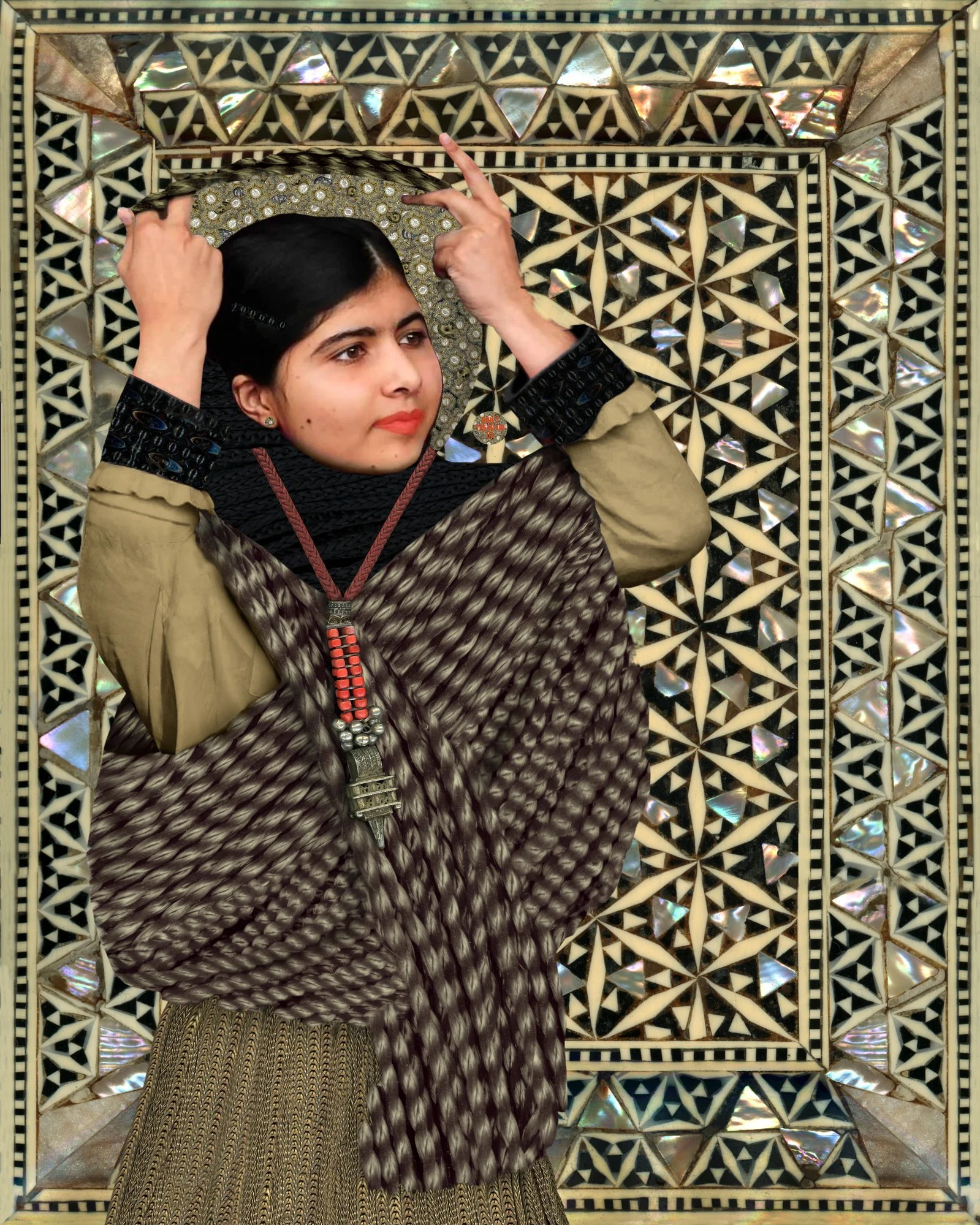
EDUCATION NOT MARRIAGE — Malala Yousafzai
HUMAN RIGHTS ACTIVIST | NOBEL PEACE LAUREATE
Malala Yousafzai stands inside a frame of inlaid mother-of-pearl and dark wood, the same geometric architecture that recurs elsewhere in this alphabet around Fatima al-Fihriya, founder of the world's oldest degree-granting university. The echo is not accidental: one woman built the institution, the other risked her life to enter one like it. Malala grew up in a Pakistani region the Taliban was actively taking over, where girls were steered toward marriage rather than school — the choice named flatly in the title, with no room between the two options. Her father, a teacher, let her study anything; by ten she was giving speeches on children's and women's education that her own community's opponents were already watching. At fifteen, gunmen boarded her school bus and shot her for it. She survived, and turned the attempt into international pressure on the Taliban's treatment of women — becoming, at seventeen, the youngest Nobel Peace Prize laureate in the prize's history. Asked about the man who tried to kill her, she said she would not shoot him if she had a gun in her hand, citing the compassion she had learned from Muhammad, Christ, and Buddha. Her raised fingers in this portrait read less like a victory sign than like a tally still being kept.