
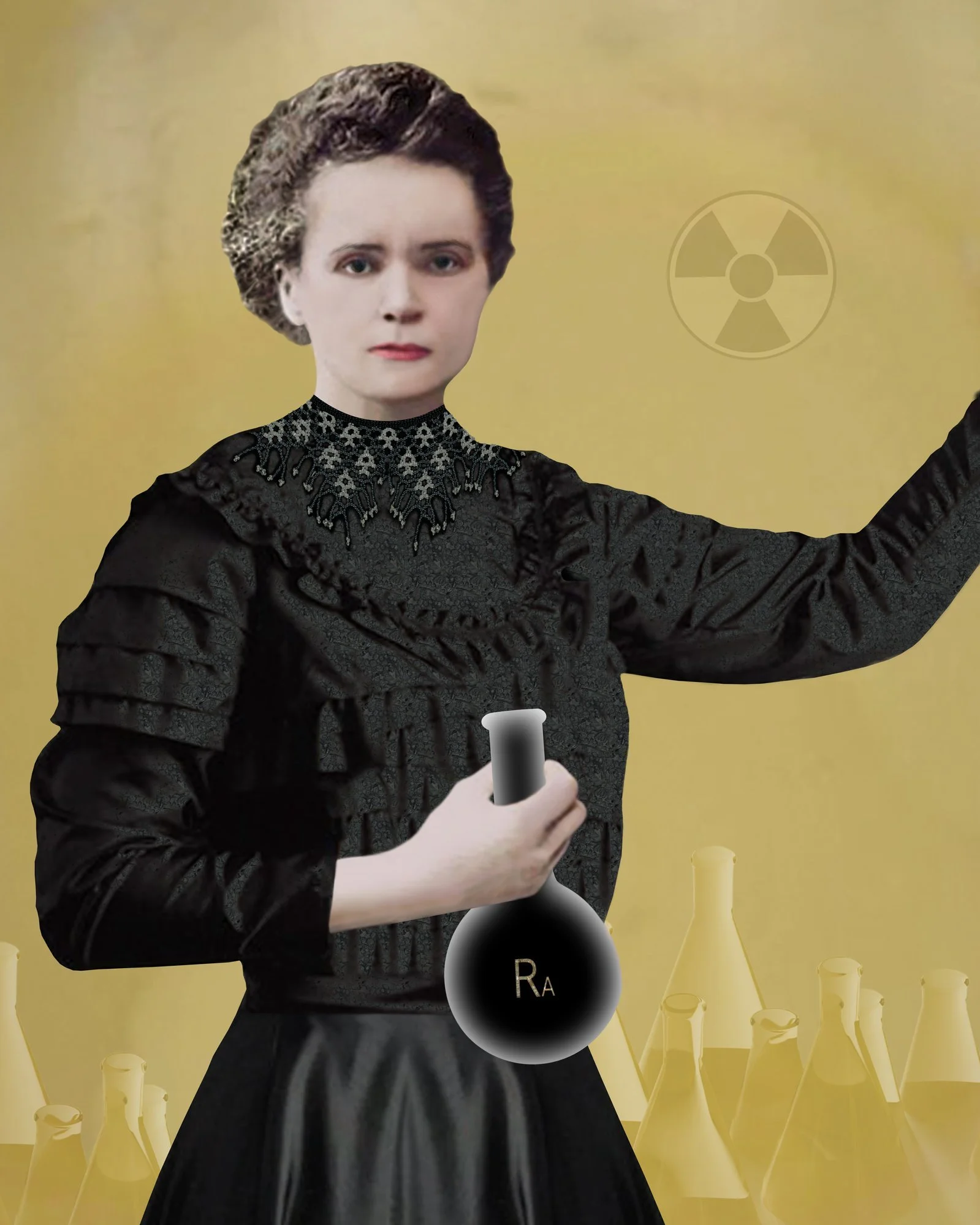
LOVE AND SCIENCE — Marie Curie
SCIENTIST | DOUBLE NOBEL PRIZE WINNER | RESEARCHER
On any list of history's essential scientists — Einstein, Galileo, Tesla, Darwin, Pasteur — Marie Curie is typically the only woman named, and the vial of radium she holds here, chalked with its element symbol, explains why. Curie and her husband Pierre, partners in both marriage and laboratory work, discovered polonium, named for her native Poland, and radium, sharing the 1903 Nobel Prize in Physics with Henri Becquerel and becoming the first woman to receive one. After Pierre's death in a street accident in 1906, she continued alone, winning a second Nobel, in Chemistry, for isolating pure radium — the only person in history to hold Nobel Prizes in two different sciences. The title's other half is less commonly told: a few years after Pierre's death, Curie's relationship with the married physicist Paul Langevin became a national scandal in a France already thick with the sexism and xenophobia the era directed at a foreign-born, Polish, Sorbonne-trained woman succeeding beyond expectation — the affair broke in the press within days of her second Nobel announcement, and she was nearly barred from the ceremony over it. She continued working regardless, first female professor at the University of Paris, first woman with a French doctorate. Curie died at sixty-six of leukemia almost certainly caused by decades of radiation exposure she didn't yet know to fear; her papers remain too radioactive to handle and are stored in lead-lined boxes. Untouchable, like Marie — in both directions the word can mean.