
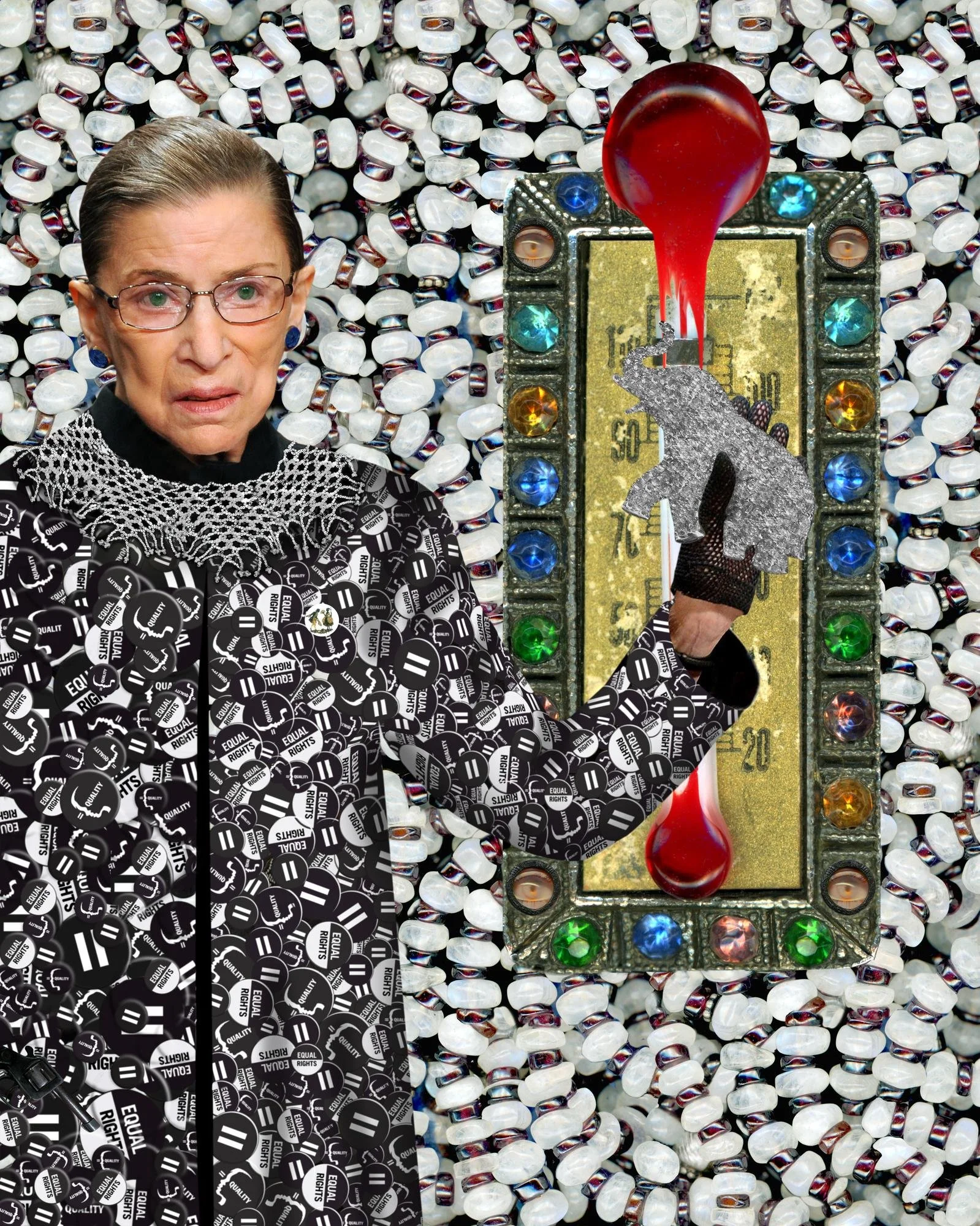
SUPREME DISSENT — Ruth Bader Ginsburg
SUPREME COURT JUSTICE | HUMAN RIGHTS ACTIVIST
A stream of red drips from the top of the frame onto a shattered silver fragment set inside a jeweled gauge, its dial marked in tens from ten to ninety — a measuring instrument, cracked, reading something closer to a countdown than a percentage. For much of her final decade on the bench, Ruth Bader Ginsburg's health became a matter of public political calculation: four cancer diagnoses, and a nation counting the years remaining in her term as though her body were the instrument determining the balance of the Supreme Court. Her judicial robe, patterned edge to edge with the words EQUAL RIGHTS repeated like a chant, is not costume but résumé: Ginsburg entered Harvard Law when a woman's seat in the classroom was considered a wasted seat, tied for first in her class at Columbia, and still could not get hired by a single law firm. She argued six gender-discrimination cases before the Supreme Court and won five, co-founded the first law journal devoted to women's rights, and became the second woman and first Jewish woman to sit on that same Court. Her fiercest legacy, though, is the title's word: dissent. Her written dissent in Ledbetter v. Goodyear was specific enough to become the blueprint for a federal law — dissent as a tool of law, not merely its record.