
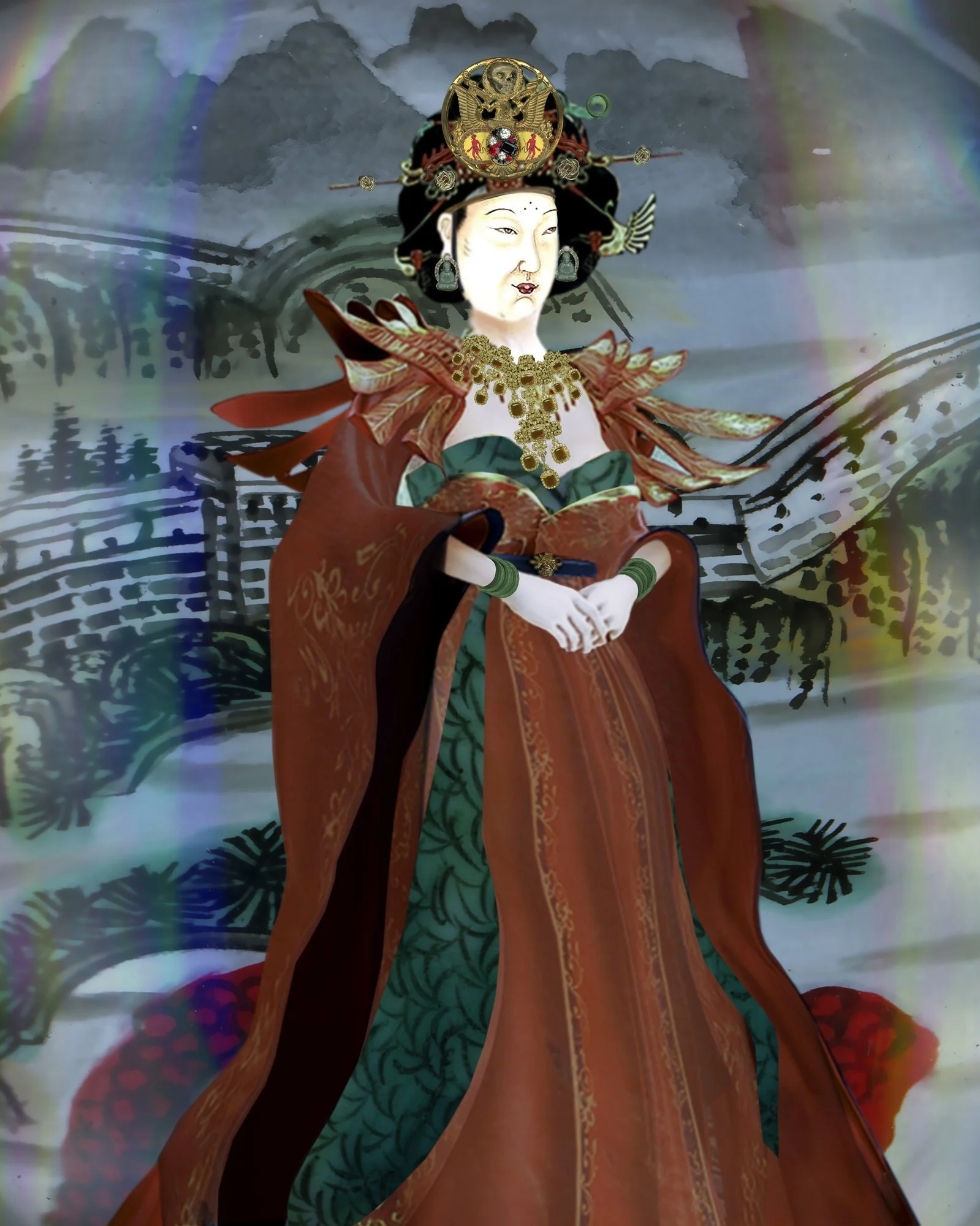
SAGE EMPRESS — Wu Zetian
REFORMER | IMPERIAL SUPREME RULER
In the seventh century, Wu Zetian became the first and only woman to rule China as sovereign in more than three thousand years of recorded succession. She is painted here in the ink-wash landscape style of her own court rather than the jeweled Western idiom used elsewhere in this alphabet — a deliberate departure, since her power was built inside a specifically Confucian order that held women should remain invisible, and she answered it on its own visual terms. Wu rose from relative obscurity, bent law when the law stood in her way, and eventually declared herself a living deity. She has also been accused across the centuries of murdering her own child, her mother, two brothers, and a sister — accusations filtered through histories written by the Confucian scholars her reign had displaced, which makes the truth of them, at this distance, genuinely unrecoverable. What is documented is the substance of her rule: she stabilized the Tang dynasty into what is still called China's Golden Age, kept peace with neighboring powers, presided over the height of the Silk Road, cut taxes, funded pensions, and commissioned a Collection of Biographies of Famous Women. She elevated Buddhism to state religion specifically to counter the Confucian doctrine that had opposed her rule, and decreed that children mourn both parents equally rather than the father alone. Whether or not "feminist" is the right word for a seventh-century absolute monarch, the record she left behind was built, point by point, against the assumption that a woman couldn't hold it.