
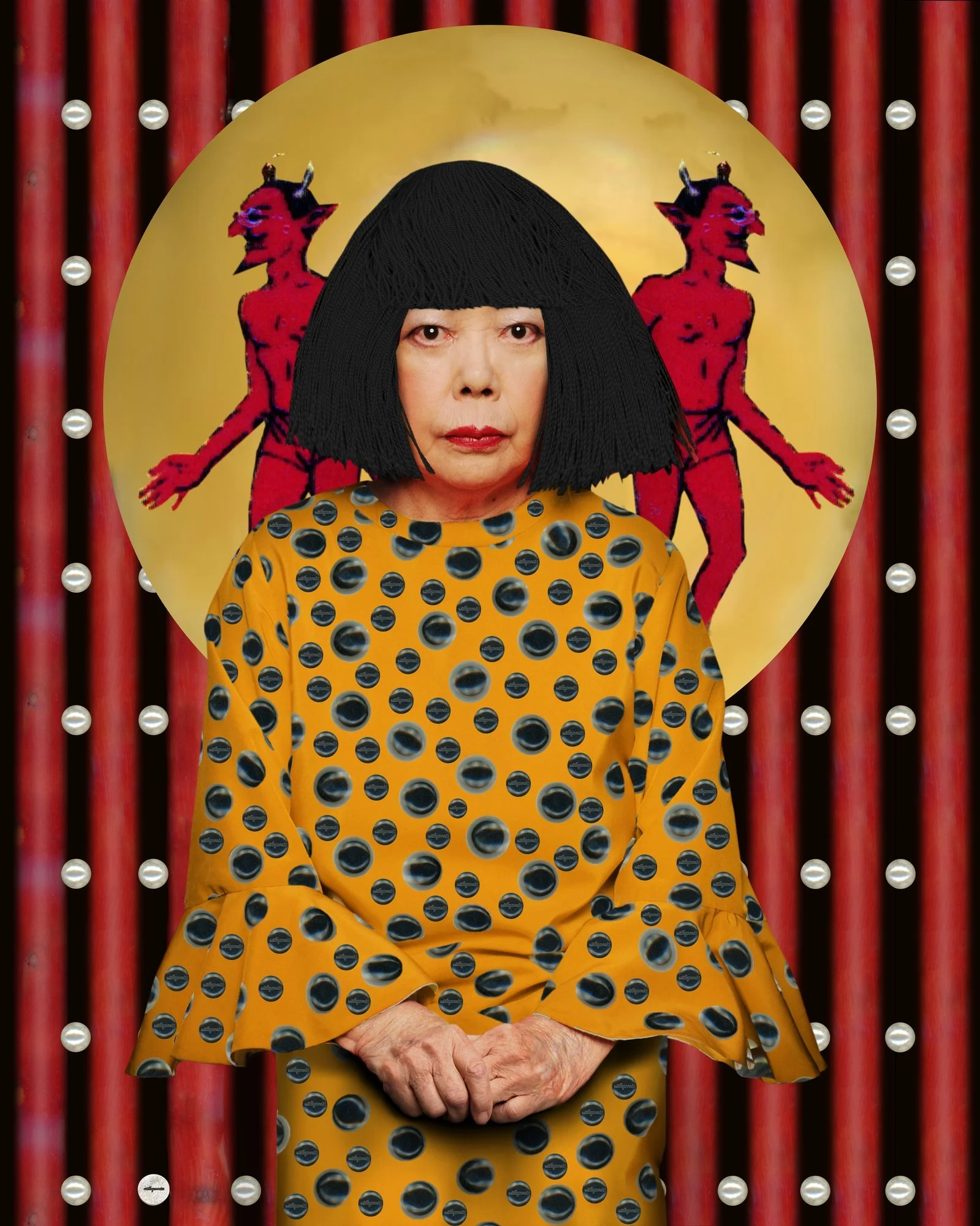
BEAUTIFUL CELL — Yayoi Kusama
ARTIST
BEAUTIFUL CELL puts a golden halo behind her and two small red devils inside it, mirrored on either side of her head like a hallucination caught mid-occurrence. Yayoi Kusama described hallucinating since childhood, fields of dots spreading across every surface and presences she could not always name, and the devils here are not generic ornament but a literal rendering of what she spent a lifetime describing. The red bars behind her double as a cell, both meanings of the title at once: the psychiatric hospital she voluntarily checked herself into decades ago and lived in for the rest of her life, and the biological cell, the repeating dot that structured nearly everything she made. Her polka-dot dress reads, on close look, as a field of small eyes rather than plain circles, watching, the way she had always insisted the dots did. Kusama arrived in New York's male-dominated art scene in the 1960s and was widely imitated by contemporaries, including Andy Warhol, without matching credit for years. For decades she crossed the street from the hospital to her studio to work. The cell in the title is real. So is the beauty she insisted on finding inside it.