
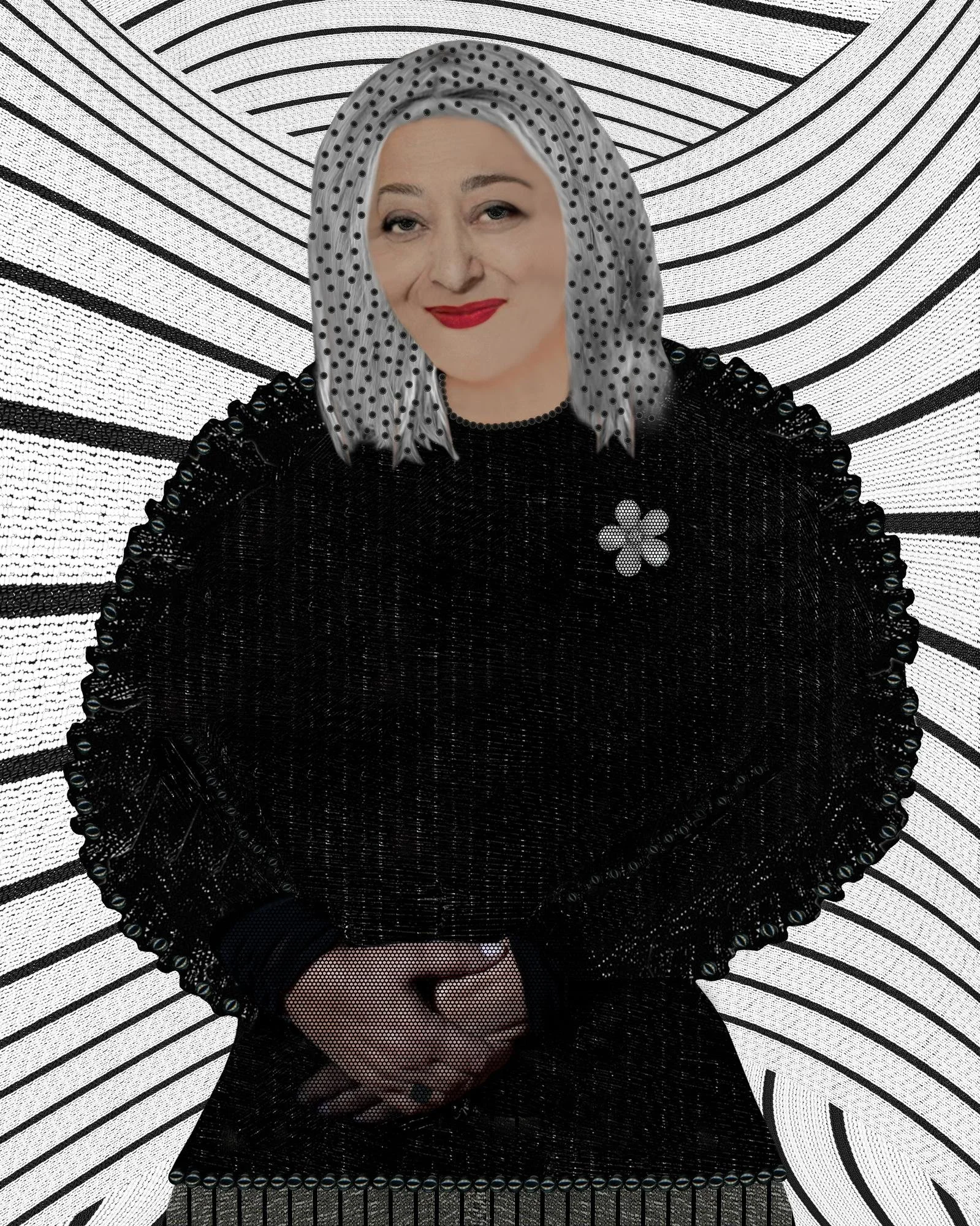
STRUCTURES — Zaha Hadid
ARCHITECT
STRUCTURES borrows its own background from her buildings. The concentric, radiating lines behind Zaha Hadid are not abstract pattern — they are the same fluid, curving logic that shaped the roof of the London Aquatics Centre and the swept form of the Guangzhou Opera House, translated from architecture into print. The collage does formally what Hadid did professionally: takes a rigid grid and bends it until it moves. Born in Baghdad in 1950 and trained at London's Architectural Association, Hadid spent her early career being told her designs were unbuildable before spending her later career proving otherwise, culminating in 2004 when she became the first woman awarded the Pritzker Prize, architecture's highest honor. She is dressed here in a garment as sculptural and structured as anything she built — dense, beaded, holding its own shape the way her concrete and steel held theirs. The background is not decoration around the portrait. It is the portrait's argument: that the woman and the work share one language, and neither one is standing still.